
An open manhole is a hazard waiting to happen, and in Maharashtra it is now a costly one. In October 2025, the Bombay High Court ordered compensation of ₹6 lakh for every death caused by a pothole or an open manhole, and held that citizens have a right to roads free from such hazards. Yet covers keep going missing or failing: cast iron covers are stolen for scrap, and concrete covers crack and break.
FRP manhole covers solve both problems. They have no scrap value, they never rust, and they are light enough for one or two people to lift. This guide explains how FRP covers work, how they compare with cast iron and concrete, how to choose the right load rating, and where to use them.
Why Manhole Covers Go Missing or Fail
Cast iron covers are stolen for scrap
Cast iron covers carry real resale value. In Mumbai, stolen cast iron covers have been reported to fetch ₹1,000–1,200 each in the scrap market, with cast iron bought at around ₹20–32 per kg. The BMC has tried several fixes. It chained covers to the drains, but thieves took both the covers and the chains. It trialled ductile iron covers, which are harder to remould and so worth less as scrap. And it has planned smart covers fitted with sensors.
Each fix adds cost without removing the reason covers are stolen: the metal itself is worth money.
Concrete covers crack and break
Precast concrete covers are low-cost and have little scrap value, but they are heavy and brittle. Edges chip when covers are lifted or dropped, and overloaded covers can crack. In reinforced concrete covers, moisture reaching the steel can cause rust, cracking and spalling over time, especially in damp drainage and sewer chambers.
Corrosion weakens covers and frames
Sewers, drains and coastal air are hard on metal. Rust attacks cast iron covers and their frames, and a corroded seating can leave a cover rocking, jammed or loose.
The cost of getting it wrong
Courts are holding civic bodies to account. At a hearing in June 2026, the Bombay High Court pulled up the Thane Municipal Corporation over its delay in paying ₹6 lakh to the family of a doctor who died after falling into a manhole, and TMC told the court it had attended to 1,351 reported cases of open or damaged manholes. For housing societies, commercial complexes and contractors too, a missing or broken cover is a safety risk and a liability.
What Is an FRP Manhole Cover?
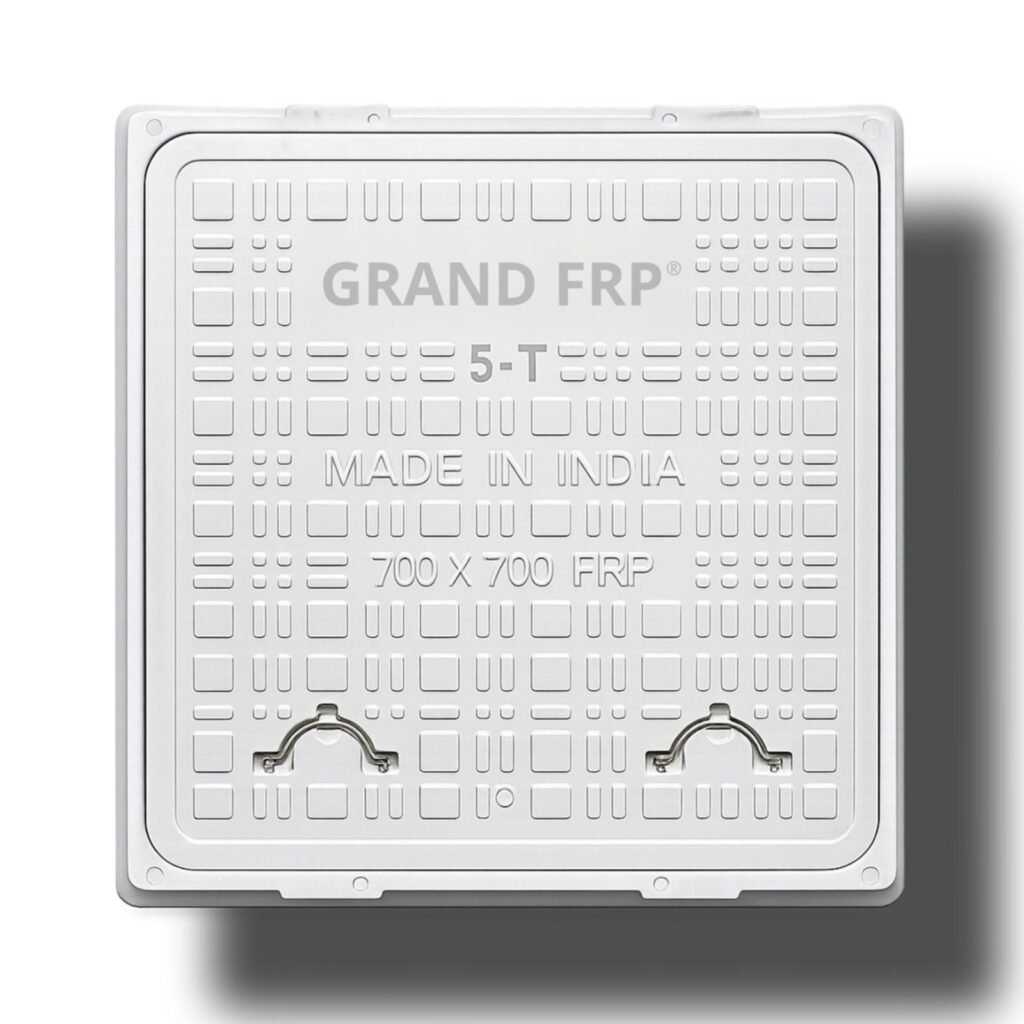
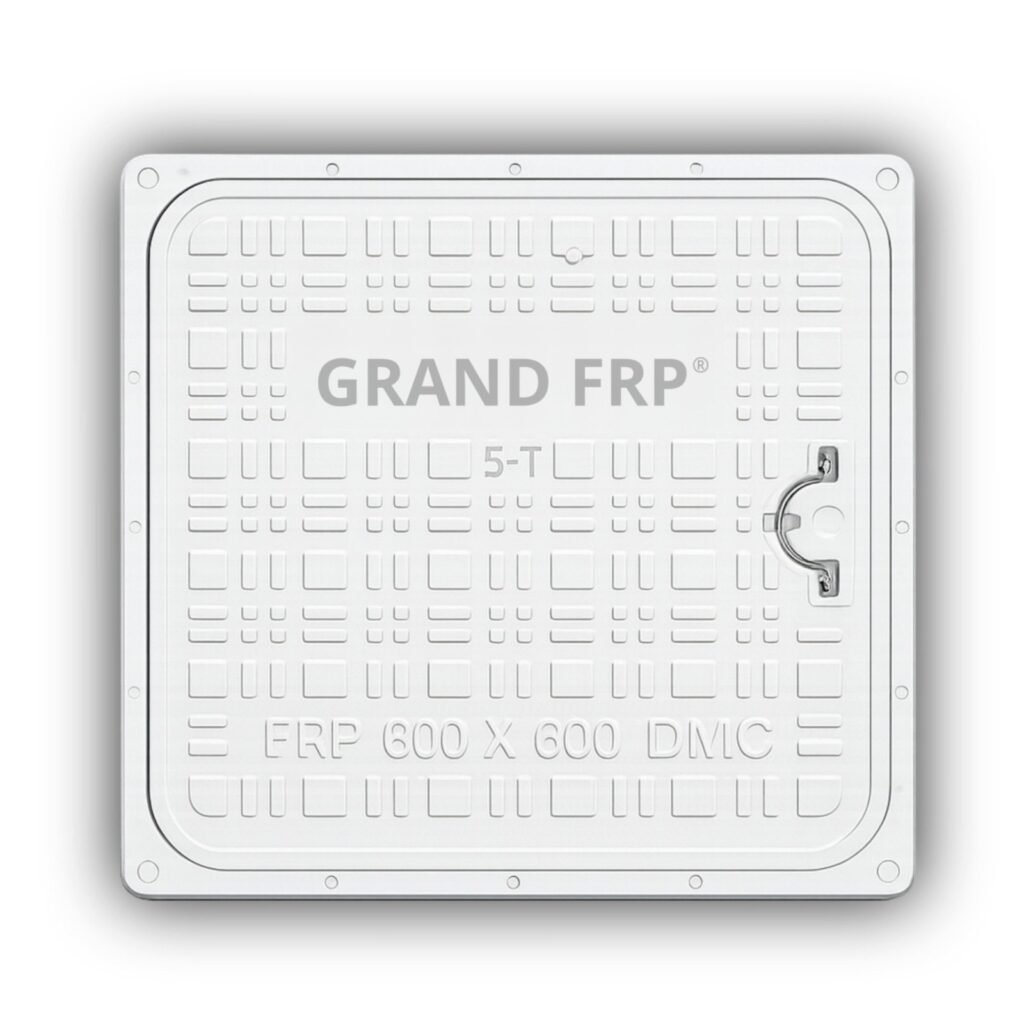
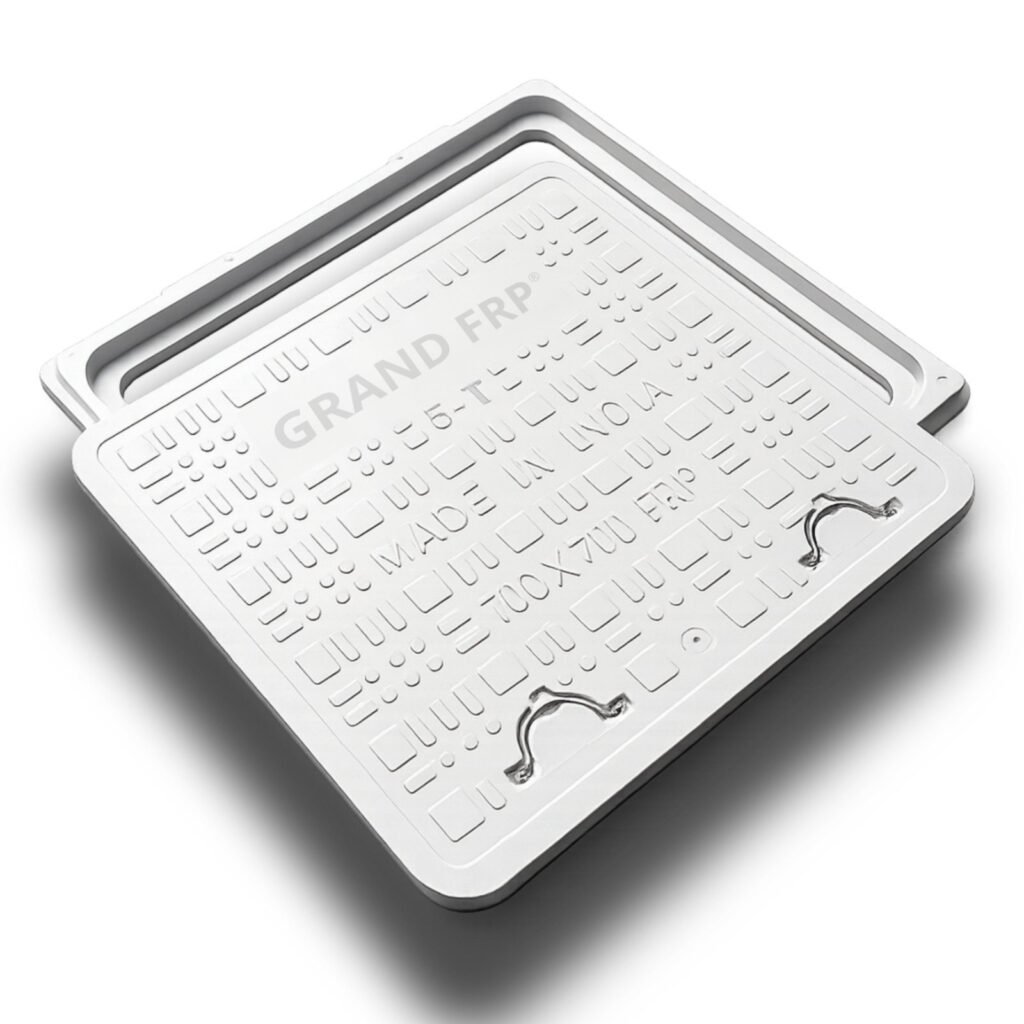
An FRP (fibre reinforced plastic) manhole cover is made from glass fibre and resin, moulded into shape under heat and pressure. The GRAND FRP® covers supplied by Grandform Fiber are compression moulded from DMC (dough moulding compound) on hydraulic presses. This produces a dense, strong cover with the anti-skid pattern, size and load rating moulded in.
Key Benefits of FRP Manhole Covers
No scrap value, so far less theft
FRP has no resale value as scrap, which removes the main reason covers are stolen. Unlike chains or locks, this protection is built into the material itself.
Rust and corrosion free
FRP does not rust or rot, even in sewer chambers, around chemicals or in salty coastal air. There is no paint or coating to wear off.
Lightweight and easy to handle
A 600 × 600 mm GRAND FRP cover weighs about 15 kg, and a 450 × 450 mm cover about 8 kg. One or two people can lift and fit them without lifting equipment, which also makes routine access for cleaning and inspection quicker and safer.
Anti-skid surface
A raised pattern moulded into the top gives better grip underfoot, even when wet. That matters on footpaths and in society compounds during the monsoon.
Non-conductive
FRP does not conduct electricity, which makes it a safer choice for electrical, cable and telecom chambers.
Low maintenance
No painting or anti-rust treatment is needed, so covers keep their look and strength with little upkeep.
Your branding, moulded in
For bulk orders, your logo or text can be moulded into the cover, which is useful for housing societies, developers and utilities.
FRP vs Cast Iron vs Concrete Manhole Covers
Each material has its place. Here is an honest comparison:
| Factor | FRP | Cast iron | Concrete |
|---|---|---|---|
| Theft risk | Very low; no scrap value | High; sold as scrap | Low; little scrap value |
| Corrosion | Does not rust | Rusts over time | Steel reinforcement can rust; concrete can be attacked in sewers |
| Weight | Light (600 × 600 mm ≈ 15 kg) | Very heavy | Very heavy |
| Handling | One or two people, no tools | Often needs lifting tools | Often needs lifting tools |
| Damage | Resists chipping in normal use | Grey cast iron can crack under impact or overload | Edges chip; can crack if dropped or overloaded |
| Electrical | Non-conductive | Conductive | Reinforced covers contain steel |
| Maintenance | Minimal | Repainting; replacing stolen covers | Replacing chipped or cracked covers |
| Best suited for | Pedestrian and light-duty areas, utility chambers, theft-prone locations; heavy-duty FRP for vehicle areas | Busy roads and heavy traffic | Low-cost, low-risk locations |
The honest verdict: on busy roads with heavy traffic, iron covers rated to the right grade remain the standard choice. In housing societies, buildings, footpaths, gardens and utility chambers, where theft, rust and handling are the real problems, FRP is usually the better fit.
Load Ratings Explained: Choosing the Right Cover
The most important decision is matching the cover’s load rating to what will pass over it.
Indian standards: IS 1726 and IS 12592
IS 1726 (cast iron covers) and IS 12592 (precast concrete covers) both use four grades, named after their test load in tonnes:
| Grade | Test load | Typical use (general guide) |
|---|---|---|
| LD-2.5 (light duty) | 2.5 tonnes | Pedestrian areas, gardens and footpaths |
| MD-10 (medium duty) | 10 tonnes | Areas with cars and light vehicles |
| HD-20 (heavy duty) | 20 tonnes | Roads carrying buses and trucks |
| EHD-35 (extra heavy duty) | 35 tonnes | Carriageways with heavy commercial vehicles |
European standard: EN 124
Many specifications also refer to EN 124, which classifies covers by test load in kilonewtons and sets a minimum class for each location. It includes a dedicated part, EN 124-5, for covers made of composite materials such as FRP.
| Class | Test load | Typical location |
|---|---|---|
| A15 | 15 kN (≈1.5 t) | Areas used only by pedestrians and cyclists |
| B125 | 125 kN (≈12.5 t) | Footways, pedestrian areas and car parks |
| C250 | 250 kN (≈25 t) | Kerbside channels of roads |
| D400 | 400 kN (≈40 t) | Road carriageways |
| E600 / F900 | 600 / 900 kN | Docks, heavy industrial yards and airports |
Where GRAND FRP covers fit
Our standard white GRAND FRP covers are rated for a 5-tonne load. In tonnage terms, that sits between the light-duty (2.5 t) and medium-duty (10 t) grades of the Indian standards, which makes them right for pedestrian and light-duty areas: society compounds, footpaths, gardens, water tanks and utility chambers. For driveways, parking areas and anywhere cars or trucks pass, choose our heavy-duty grey covers, available on request.
Where FRP Manhole Covers Are Used
- Residential: housing societies, apartments, bungalows and villas
- Commercial and institutional: malls, offices, schools, hospitals and campuses
- Public spaces: footpaths, walkways, gardens and landscaped areas
- Water: water tanks, sumps and rainwater harvesting pits
- Drainage: sewer, storm water and drainage chambers
- Utilities: electrical, cable, telecom and fibre chambers
- Industrial: factory walkways and utility areas
The Shift to Composite Covers
Globally, the change is already under way. Mordor Intelligence estimates the manhole cover market at USD 5.72 billion in 2025, growing to USD 7.66 billion by 2031. Cast iron still held the largest share, about 45.89% of 2025 revenue, but composite covers are forecast to grow faster, at 5.88% a year. Volatile iron scrap prices are one reason municipalities are considering composite alternatives with more stable pricing, and telecom and data networks are the fastest-growing application.
Buying and Installation Checklist
- Measure the opening. Check the clear opening and the space for the frame. GRAND FRP sizes are listed by outer frame size, from 250 × 250 mm to 900 × 900 mm.
- Match the load rating to the traffic. White 5-tonne covers for pedestrian and light-duty areas; heavy-duty grey covers wherever vehicles pass.
- Order cover and frame together so they fit and seat properly.
- Set the frame level and firm on the chamber in mortar or concrete, so the cover sits flush and does not rock.
- Choose an anti-skid surface for walkways and wet areas.
- Plan branding for bulk orders: your logo or society name can be moulded in.
- Ask for test reports for the size and load rating you are buying.
FAQs: FRP Manhole Covers
Are FRP manhole covers strong enough?
Yes, when the load rating matches the location. Our white 5-tonne covers are made for pedestrian and light-duty areas, and heavy-duty grey covers are available for places where vehicles pass.
Can FRP manhole covers be used on roads?
Only covers rated for vehicle loads. Use heavy-duty covers for driveways and parking areas. For busy public roads, specify a cover tested to the heavy-duty grade or class the road authority requires.
Will FRP manhole covers get stolen?
They are far less likely to be. FRP has no scrap value, so there is little reason to steal them.
How much does an FRP manhole cover weigh?
Our covers range from about 2.2 kg for a 250 × 250 mm cover to about 40 kg for a 900 × 900 mm cover. A 600 × 600 mm cover weighs about 15 kg.
Do FRP manhole covers rust?
No. FRP contains no iron, so it cannot rust, even in sewers or coastal areas.
Do the covers come with frames?
Yes. Every GRAND FRP cover is supplied with a matching FRP frame, ready to fix in place.
Get FRP Manhole Covers from Grandform Fiber
Grandform Fiber supplies GRAND FRP® manhole covers with matching frames in 16 standard sizes, from 250 × 250 mm to 900 × 900 mm, with heavy-duty grey covers on request and pan-India dispatch. See every size, weight and specification on our FRP manhole cover page. We also supply FRP gratings and GFRP rebars.
Sources
- Moneylife, Bombay HC orders ₹6 lakh compensation for pothole and open manhole deaths (October 2025)
- Free Press Journal, Bombay HC seeks assurance against manhole deaths (June 2026)
- Business Standard, BMC plans smart sensors to curb manhole cover thefts (August 2024)
- IS 1726:1991, Cast iron manhole covers and frames
- Bureau of Indian Standards, IS 12592:2002 precast concrete manhole covers and frames (grade designations)
- Understanding EN 124 groups and classes
- Mordor Intelligence, Manhole Covers Market