
On a purchase order, steel grating almost always looks cheaper than FRP grating. But in wet, chemical or coastal plants, the purchase price is only the first cost. Repainting, re-galvanising, replacing rusted panels and shutting areas down for repairs keep adding to the bill for as long as the plant runs.
This guide compares FRP and steel grating honestly, including where steel still makes sense, shows how to work out the true lifecycle cost for your site, and ends with a checklist for specifying FRP grating.
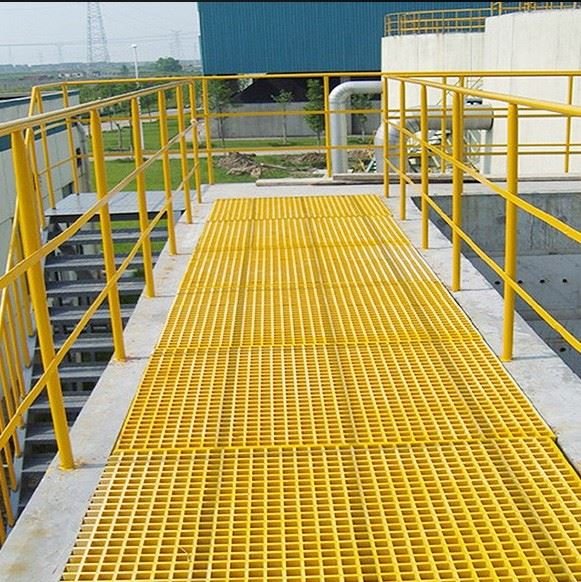
Corrosion Is Costing India About $180 Billion a Year
In August 2026, a Nomura Research Institute (NRI) report titled Built to Last estimated that India loses about 4.3% of its GDP to corrosion, roughly $180 billion every year. That is higher than the global average of 3.4%. The report estimates that better corrosion management could add around 1.5% to GDP, a saving of nearly $63 billion a year.
Some sectors are hit far harder than others. NRI found that power generation and transmission loses about 10.1% of its sectoral GDP to corrosion, and put Indian Railways’ annual corrosion losses at around $3 billion.
Its diagnosis is directly relevant to anyone buying grating: Indian engineering and procurement practices tend to prioritise upfront construction cost over long-term asset performance. Among its recommendations, NRI calls for lifecycle cost analysis on public infrastructure projects and wider use of corrosion-resistant materials in harsh environments.
Gratings are a textbook case. They are open to air and moisture from every side, walked on every day, and often installed over drains, tanks and process areas. When a steel grating corrodes, it is not just a maintenance issue: bars lose thickness, and a weakened panel underfoot is a safety risk.
Why Steel Grating Corrodes So Quickly in Indian Plants
Mild steel grating rusts as soon as its paint is damaged. Hot-dip galvanising protects it much better, but the zinc layer is gradually used up, and it wears faster in wet, acidic, salty or chemical conditions. Cutting, welding and scratches on site also expose bare steel.
Indian conditions speed all of this up:
- Monsoon and humidity: months of rain and high humidity keep steel damp for long periods.
- Coastal air: salt-laden air along the coasts of Maharashtra, Gujarat, Tamil Nadu and beyond attacks steel and zinc coatings.
- Process environments: sewage and effluent treatment plants, chemical and fertiliser units, and plating or pickling areas expose grating to gases, acids and spills.
- Wash-down areas: food, pharma and car wash facilities are wet every day.
What Makes FRP Grating Different
FRP (fibre reinforced plastic) grating, also called GRP grating, is made from E-glass fibre reinforcement encapsulated in a thermosetting resin. There is no iron in it, so it cannot rust. Its key properties:
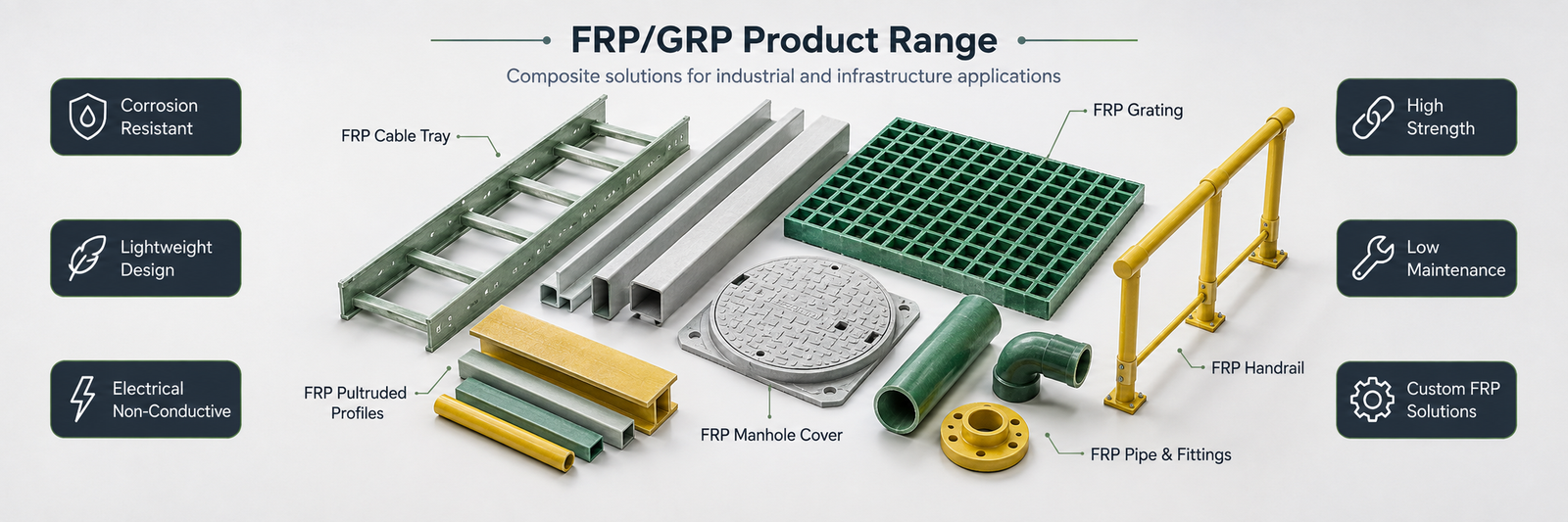
- Corrosion resistant: resists moisture and many chemicals, with the resin system chosen to suit the environment.
- Lightweight: typically one-third to one-half the weight of comparable steel grating, depending on the design, so panels can often be carried and fitted by hand.
- Anti-slip: concave or gritted surfaces are moulded in, rather than added as a coating.
- Non-conductive: suits substations, power plants and areas near electrical equipment.
- Low maintenance: no painting or galvanising repairs.
FRP grating comes in two main constructions. Moulded grating has equal strength in both directions and good corrosion and impact resistance, which makes it the usual choice for walkways, platforms and trench covers. Pultruded grating uses high-glass-content bearing bars in one direction and suits longer spans and heavier loads. See the full range on our FRP gratings page.
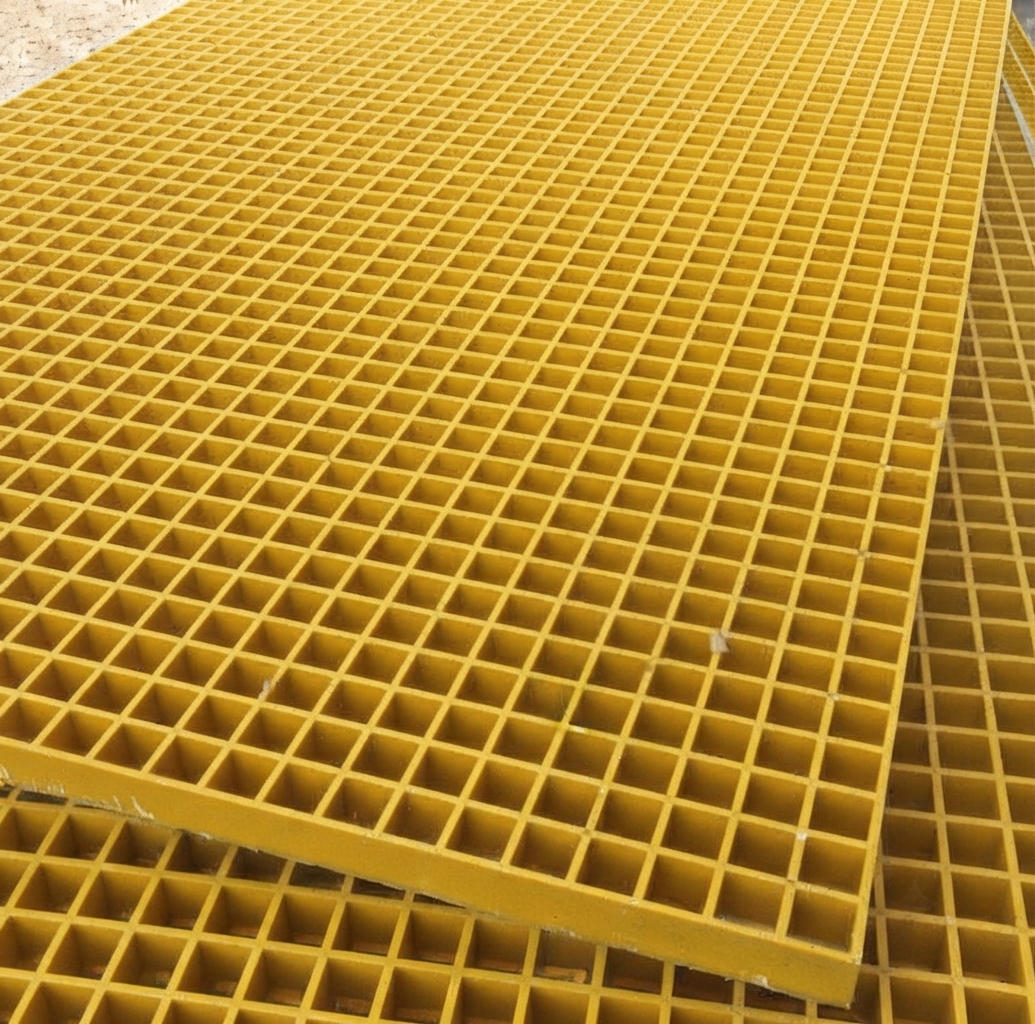
FRP vs Steel Grating: Side-by-Side
Neither material wins on every point. Here is how they compare:
| Factor | FRP grating | Mild steel / galvanised grating |
|---|---|---|
| Corrosion | Does not rust; resin chosen for the chemicals present | Rusts once paint or zinc is worn or damaged |
| Weight | Typically one-third to one-half of steel | Heavy; may need lifting equipment |
| Upfront material cost | Higher | Lower |
| Installation | Cut with hand tools; fixed with clips; no hot work | Often needs welding, cranes and hot-work permits |
| Maintenance | Occasional cleaning and inspection | Repainting, galvanising repairs and panel replacement |
| Slip resistance | Anti-slip surface moulded in | Serrated bars or added coatings |
| Electrical | Non-conductive | Conductive |
| Strength and stiffness | Good for its weight; designed using load and deflection tables | Stronger and stiffer, especially for heavy vehicle loads |
| Fire | Fire-retardant grades must be specified and tested | Non-combustible |
| Sunlight | Surface can weather under prolonged UV; use UV-stabilised grades outdoors | Unaffected by UV |
| Recycling | Difficult to recycle | Easily recycled |
How to Calculate the True Lifecycle Cost
To compare fairly, add up everything each option will cost over the same period, not just the purchase price:
Lifecycle cost = Purchase + Installation + (Maintenance × number of cycles) + Replacement + Downtime
- Set the period. Use the design life of the plant or area, not just the warranty period.
- Count the maintenance cycles. Use your own records: how often has steel grating in this area needed repainting, re-galvanising or replacing?
- Price the installation properly. Include cranes or lifting, welding, hot-work permits, labour and time on site.
- Add downtime. Every maintenance shutdown has a production or service cost. In many plants, this is the biggest number.
- Include safety. Corroded grating needs more frequent inspection, and a failure underfoot carries a cost no budget wants.
In a dry, indoor area, steel may need almost no maintenance, and its lower price wins. In a corrosive area where steel needs repainting or replacing several times over the plant’s life, each of those cycles, and each shutdown, shifts the balance towards FRP.
Where FRP Grating Pays Off
- Sewage and effluent treatment plants: walkways over tanks, clarifiers and channels face constant moisture and corrosive gases. This is a large market: a parliamentary committee report in August 2026 noted that only 658 MLD of the 6,815 MLD of sewage treatment capacity taken up under AMRUT 2.0 had been operationalised, with the mission extended to March 2027.
- Chemical, fertiliser and pharma plants: spills and fumes attack steel and its coatings.
- Power plants and substations: non-conductive FRP adds an electrical safety margin, in the sector NRI found most affected by corrosion.
- Coastal sites, ports and jetties: salt air is one of the fastest routes to steel corrosion.
- Cooling towers, pump houses and wash-down areas: permanently wet conditions where steel struggles.
- Trench and drain covers: lightweight panels are easy to lift for cleaning and access.
Where Steel Grating Still Makes Sense
FRP is not the right answer everywhere. Steel can be the better choice for dry, indoor areas with little corrosion risk; heavy vehicle traffic or very long spans where steel’s stiffness matters; high-temperature zones; and projects where recyclability is a priority. A good supplier should tell you when steel is the better fit.
Buyer’s Checklist: Specifying FRP Grating
- Choose the construction. Moulded for general walkways, platforms and trench covers; pultruded for longer spans and heavier point loads.
- Match the resin to the environment. Orthophthalic polyester for general use, isophthalic for better chemical resistance, and vinyl ester for aggressive chemicals. Share the chemicals present with your supplier.
- Check load and deflection. Ask for load and span tables. A common walkway specification is a 65 psf (about 3.1 kPa) uniform load with deflection no more than 3/8 inch (about 10 mm) or span/120, or a 250 lb (about 1.1 kN) concentrated load. Set your own values for your loads.
- Specify fire performance. Typical specifications require a flame spread rating of 25 or less in the ASTM E84 test and self-extinguishing behaviour under ASTM D635. Ask for the test reports.
- Pick the surface. Concave or gritted anti-slip tops for wet or oily areas; covered (solid top) grating where small objects or spills must not fall through.
- Select mesh and thickness. 38 × 38 mm mesh is common; mini-mesh suits public walkways and heel safety. Thickness (typically 25–50 mm) follows from the load and span.
- Plan for sunlight. For outdoor areas, ask about UV-stabilised resin or protective coatings.
- Order accessories. Fixing clips and edge banding, and make sure cut edges on site are sealed with resin to keep the corrosion barrier intact.
FAQs: FRP vs Steel Grating
Is FRP grating cheaper than steel grating?
Not usually on the purchase price. In corrosive or wet areas, it often costs less over the life of the plant once installation, maintenance, replacement and downtime are included. Run the lifecycle calculation above for your site.
How long does FRP grating last?
FRP does not rust, which supports a long service life with little maintenance. Actual life depends on the resin, loading and exposure, so no single figure applies to every site.
Is FRP grating strong enough for heavy loads?
Pultruded and heavy-duty FRP gratings are designed for heavier loads and longer spans. Always check the load and deflection tables for your span. For heavy vehicle traffic, steel may still be the better choice.
Is FRP grating fire-safe?
Fire-retardant grades are available. Specify a flame spread rating of 25 or less under ASTM E84 and self-extinguishing performance under ASTM D635, and ask for test reports.
Can FRP grating be cut on site?
Yes, with a diamond or carbide blade. Seal the cut edges with resin to maintain corrosion resistance.
Can FRP grating be recycled?
Not easily. Steel is readily recyclable, which is a genuine advantage. FRP’s case rests on lasting much longer in corrosive areas, so fewer replacements are needed.
Get FRP Gratings from Grandform Fiber
Grandform Fiber supplies moulded, pultruded, covered-top and mini-mesh FRP gratings, plus stair treads and accessories, with pan-India dispatch. We also make FRP manhole covers and GFRP rebars for corrosion-free projects. Share your application, panel size, mesh, thickness and quantity on WhatsApp, or visit our Contact Us page.